







Scroll to questions about.
Driver's license
What driving licence do I need, and what do the trailers weigh?
On a category B licence you can tow up to 750 kg; above that the combined weight limit of 3,500 kg applies and you need BE. Our trailers run from around 1,900 kg empty for a Streamline 550 to 2,340 kg for a Streamline 670. Most people assume they are limited to the smallest model, and that is usually not true. Ask us for advice with your licence and your vehicle, and we will tell you exactly what you can tow.
What driving licence do I need for a BBQ trailer, and is it road legal?
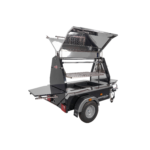
On a category B licence you can tow a trailer up to 750 kg; above that the combined weight limit of 3,500 kg applies and you need BE. Our BBQ trailers come with a registration document and a CoC, so they are road legal across Europe. Do not assume you are limited to the smallest model, because that is not usually the case: ask us for advice with your vehicle and licence, and we will tell you what you can actually tow.
What is the maximum speed I can drive with my food trailer?
Germany: The maximum speed for a food trailer is 80 km/h unless the trailer + load weighs less than 3,500 kg, in which case it can go up to 100 km/h.
Netherlands: The maximum speed is 90 km/h if the trailer + load is under 3,500 kg, and 80 km/h if it exceeds 3,500 kg.
France: The maximum speed is 90 km/h for trailers weighing up to 3,500 kg and 80 km/h for trailers exceeding this weight.
Do I need a special driving license to drive a food trailer?
Germany: With a B license, you can tow trailers under 750 kg. If the total combined weight (vehicle + trailer) exceeds 3500 kg, a BE license is required.
Netherlands: With a B license, you can tow trailers under 750 kg, and the combined weight must be under 3500 kg. If it exceeds, you’ll need a BE license.
France: With a B license, you can tow trailers under 750 kg. If the total weight exceeds 3500 kg, you’ll need a BE license.
Equipment
What do I need for food hygiene?
You work to a food safety plan, with handwashing, a sink with fresh and waste water, and refrigeration you can monitor. Tell us which country you will be inspected in, because the inspection differs, and we build the unit so you pass it.
Which machine fits my trailer?
That depends on your menu, your pitches and the power you will have, and there is no single right answer. Our advisers go through it with you, so you are not piecing it together from forum posts and spec sheets and discovering after delivery that the machine cannot keep up.
How many coffees an hour can I make?
On a busy pitch, around fifty shots an hour is the benchmark people work to. A two-group machine with automatic dosing will hold that; a domestic machine will not. In practice the bottleneck is rarely the machine but the grinding and the payment, so we look at those in the layout too.
Can I make coffee without a mains water connection?
Yes, with a fresh water tank and a pump you are self-sufficient, and a fixed mains connection is possible where the pitch allows it. For planning, count on roughly a fifth of a litre of water per cup, including rinsing the group and steaming milk. Fifty litres is therefore around 250 cups. Waste goes to a separate tank, and you need to be able to empty that as easily as you fill the fresh one.
My generator drops as soon as the machine heats up. How do I fix that?
This is the classic coffee-on-site problem: the machine draws a peak while heating that an undersized generator cannot deliver, and your brew temperature drops with it. The fix is in the rating and the start-up current, not just the number on the data plate. We allow for that peak when we design the build.
How much power does an espresso machine in a coffee trailer need?
It depends on the machine, and the difference between models is large enough that it decides what you can run on a given pitch. That is the wrong thing to work out on your own from a spec sheet: tell us what you want to serve and where you will be standing, and our advisers will match the machine to the supply you will actually have.
Can my extraction hood be rejected after it has been approved before?
It happens, and it is an expensive surprise, because then either the concept goes or the hood does. Tell us up front what you will be frying or grilling and we build the extraction for that rather than for a lighter menu.
What do I need for food hygiene, and does it apply to my staff?
You work to a food safety plan, with handwashing, separate sinks, refrigeration with temperature monitoring and lockable storage. Everyone working in the unit falls under the same requirements you do, including part-time and stand-in staff.
How much water do the trailers carry?
Every model has a 20 litre fresh water tank as standard, and a fixed mains water connection is possible if your pitch allows it. Plan around that: if you are serving all day without a connection, you will be refilling, and a full tank also adds weight to what you tow.
How do I get power on site?
Three routes: a mains hook-up at the pitch, a generator, or batteries with an inverter. Add up the load of your equipment first, because that decides whether a normal socket will do or you need three-phase. Our trailers come with a 400 volt connection and we work your load through at the design stage. Ask about noise as well: many councils and venues set a noise limit as a condition of the pitch, so a quiet generator is often what decides whether you get the spot.
Can we take card payments from the cart?
The cart has a triple pop-up socket built into the worktop, so a till or a card terminal has power without trailing cables across the bar. At cashless events that is a requirement rather than a nice extra.
Can it be branded in our own colours?
Yes. The cart can be fully wrapped in your own design, or fitted with interchangeable magnetic panels if you use it for several brands or events.
Can I have a beer tap on it?
Yes, there is a version with a tap installation. With draught you need a cooled line and enough throughput, so tell us how many drinks per hour you expect and we will advise tap or bottles.
Can I use it indoors without damaging the floor?
It runs on four castors with ball bearings and brakes, so one person can roll it into place and lock it there. On a delicate floor such as parquet, check the wheels and the route with us beforehand.
How long does it stay cold?
That depends on the ambient temperature, how full the unit is and how often it is opened, so treat it as something to plan rather than a fixed figure. Pre-cooling before you set off makes the biggest difference, and on a site with a socket you simply keep it running.
Does the mobile bar need a power supply, or does it run on a battery?
The Coolrolly runs on 230 volt, so a standard socket, and you do not need three-phase power. That is exactly why it works in hotels, offices and shops where a generator is not an option. There is no built-in battery version, but for sites with no supply at all you can run it from a generator or a portable battery pack, and we can supply a battery pack with it.
Financial
Who owns the trailer during the lease, and what happens at the end?
With a financial lease you are the economic owner from the start: the trailer is on your balance sheet and at the end of the term it is yours outright. With an operational lease you are effectively renting and hand it back. In Sweden leasing works differently: the leasing company owns the vehicle throughout and you are the user, with a residual value of twenty percent at the end of a term of twenty four to sixty months. We will tell you which form applies in your country before you sign.
How long does an application take?
In the Netherlands you usually have an answer within one to two working days. In Germany and Austria the credit check takes twenty four to forty eight hours once your documents are in. In Belgium allow three to four working days, because supporting documents are always required there and cannot be submitted in advance. A complex file takes longer.
Do I have to pay the VAT up front?
Usually yes. Finance is normally arranged on the amount excluding VAT and the VAT is paid as an advance, so plan for that separately from your deposit. There are exceptions, and some lenders can include it. Ask us early, because this is the item that most often catches people out when the invoice arrives.
Will the BBQ fit through a gate, and can I load it into a van?
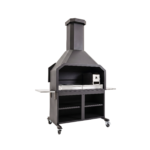
The 600 Grillmaster is around 300 kg and stands 1,930 mm high with the gullwing doors open, so measure the height of any gate or doorway with the doors up, not closed. It runs on 10 inch wheels with sealed bearings, so it rolls over gravel and grass rather than only over smooth ground. Tell us the access route to your pitch and we will tell you whether it will make it in.
Can I run this alongside a job?
Yes, plenty of coffee carts run part-time and at events. Be aware that commercial use affects your insurance, certainly with a gas bottle and boiling water on board, so declare the use to your insurer rather than finding out afterwards.
What does a food truck cost in total, including the fit-out?
The trailer itself is on average around three quarters of the investment, and the fit-out the remaining quarter. With a full wrap and several certifications that shifts, and it can end up closer to sixty percent trailer and forty percent everything else. On top of that come licences, insurance and working capital. The most common mistake is budgeting the bare unit price and running out of money halfway through the build.
What will my trailer be worth if I sell it?
There is no official price guide for food trailers, so value comes down to condition, paperwork and how broadly usable the fit-out is. A trailer with a registration document, a CoC and current inspections demonstrably sells more easily than a self-build without papers.
What should I watch for in the contract?
Look at the penalty for early settlement, the obligations around insurance and maintenance, and whether there is a balloon payment at the end that you have to find in one go. Get the schedule and have your accountant read it before you sign.
Can I finance the equipment and fit-out as well as the trailer?
Yes. Equipment, fit-out and branding can go into the same agreement. That matters more than people expect, because the trailer is only part of the investment: on average it is around three quarters, and with a full wrap and several certifications it can drop closer to sixty percent of the total.
What happens if I want to stop early or sell?
You settle the outstanding balance. If you sell for less than that, the difference stays as a debt, and that is where owners get caught out. Ask for the amortisation schedule up front so you can see what is outstanding in each year, and factor that into how long you commit for.
Can I lease with an option to buy at the end?
With a financial lease that is built in: once the term is paid off, the trailer is yours. That is what most starters are looking for and it is why this is the usual route in our market.
What is the difference between financial lease and operational lease?
With a financial lease you become the economic owner: the trailer is on your balance sheet, you depreciate it, and at the end of the term it is yours. With an operational lease you are effectively renting for a fixed period and hand it back at the end. Most of our customers go the financial lease route because they want to own the unit.
In which countries can I finance?
The Netherlands, Belgium, Luxembourg, France, Germany, Austria, Switzerland, Italy, Spain and Sweden, and the United Kingdom through AFS UK Ltd. Beyond those we can approach a lender in most European countries, so ask even if your country is not on the list. Terms and timescales differ per country and we will tell you what applies to yours.
Which lenders do you work with?
It differs per country, and we are deliberately not tied to one. In the United Kingdom we work with AFS UK Ltd. In the Netherlands with TK Lease and DTC Lease, in Belgium with TK Lease and KBC Lease, in France with Corhofi, Leasy and TK Lease, and in Germany and Austria with LeaseForce, PEAC, AGL Hannover and ABCFinance. Several of those place your file with a number of banks in turn, which is why a refusal at one desk says nothing about the next.
How much do I need to put in myself?
That depends on the funder, the country and your figures. Deposits generally sit somewhere between nothing at all and around a third of the amount excluding VAT. A larger deposit lowers the monthly payment and improves your chances of approval, so tell us what you have available and we will tell you straight away what is realistic.
Can I lease a food trailer as a startup?
It depends on the lender and the country. In the United Kingdom we work with a dedicated asset finance partner, and outside our core markets we can approach a lender in most European countries for you. What counts for more than how long you have existed is your turnover, your result and a plan that holds up. Do not assume the answer is no: send us your situation and we will tell you which route is open before you spend time on paperwork. It depends on the lender and the country. In the United Kingdom we work with a dedicated asset finance partner, and outside our core markets we can approach a lender in most European countries for you. What counts for more than how long you have existed is your turnover, your result and a plan that holds up. Do not assume the answer is no: send us your situation and we will tell you which route is open before you spend time on paperwork.
Maintenance
Can stainless steel still rust?
Yes, and it catches new owners out. Stainless can stain and spot from contact with ordinary steel, from road salt, from scouring pads and from cleaning products containing chlorine. Rinse with clean water after use, keep steel wool away from it and use no chlorine-based cleaner, and the surface stays intact.
How do I clean it, and where does the meltwater go?
There is a small condensation hole in the bottom of the fridge section, so any dripping water drains away there. For cleaning, a cloth and ordinary detergent is all it needs. Rinse after use and leave it open to dry, and the cooling section stays odour free.
Can it stay outside?
Yes, it can stand outside and it handles rain. We do recommend the cover, because it protects against scratches in transport and against rain, which is what causes rust and staining over time. With the cover you get considerably more years out of it.
How do I clean the grates?
Brush them while they are still hot, that takes the least effort. For anything stubborn, lay a sheet of aluminium foil over the area while the unit heats up, then brush it away. Do not use oven cleaner and do not leave the grates soaking, because that strips the layer that protects them and keeps them non-stick. Re-oil them with a high smoke point oil every few cooks.
Will it rust, and how do I maintain it?
Rust starts on the inside, from moisture and fat left standing, not from the outside. Clear out the ash and the fat after every cook, run it dry now and then, and keep it under a cover. Re-oil the inside when the layer starts to look dull. Every unit comes with one year of warranty.
Do I need to season the smoker before first use?
Yes, and do it before any food goes in. Wash the inside with water and a little soap to remove manufacturing residue. Coat the whole interior, the firebox and the grates with a high smoke point oil such as sunflower, rapeseed or groundnut oil, and leave it for fifteen minutes. Then run it empty for two to three hours at around 120 to 135 degrees. Let it cool and wipe it down with a soft cloth. The dark, glossy layer you are left with is what protects the steel from rusting out from the inside.
How long does a catering container unit last?
With a new build that is properly insulated and finished you are looking at decades, as long as the steel is never left damp on the inside. Lifespan comes down to the build and the maintenance rather than to the container itself. Every unit comes with one year of warranty.
Can a catering container unit grow mould inside?
Mould is what follows condensation, and the ceiling is where it starts, because that is where moisture settles first. In a room where food is prepared that is an inspection problem, not a cosmetic one. The answer is in how the unit is built and finished, not in an appliance added afterwards.
Does a container cafe or catering kiosk get condensation?
Condensation happens when warm, moist air meets cold steel, and insulation on its own does not solve it. A kitchen is harder than a home, because cooking and washing up produce steam all day. Our units are insulated as a complete build, walls finished in stainless steel or polyester, so there is no bare cold surface left for moisture to settle on. That is the difference with a self-built conversion, where owners report that it rains inside even with fans and a dehumidifier running.
Is there a warranty on the models?
Our models come with a one-year carry-in warranty. If a defect occurs within this period, you can bring the model to us, and we will repair the issue for you. The warranty only covers defects that occur under proper usage of the model.
Do you offer service and maintenance?
At Multiwagon, we offer comprehensive maintenance and support through our in-house workshop, equipped for regular maintenance, technical repairs, and custom modifications. Our dedicated service department is also available to assist with any questions or issues you may have, ensuring smooth operations for your Multiwagon. Our service department is always ready to support you with all your questions and problems.
What should I do to prepare my trailer for winter?
In winter or during extended periods of non-use, make sure to thoroughly clean the trailer to prevent vermin. Drain the water from pipes, tanks, and drainpipes to avoid freezing and damage. Also, check tire pressure and remove the gas bottles for safety.
Does a food trailer need to be inspected annually?
Germany: Food trailers must undergo a mandatory inspection (TÜV) every two years to ensure they are roadworthy and compliant with regulations. We recommend annual maintenance checks to keep your trailer in top shape.
Netherlands: Larger trailers (over 750 kg) require a periodic roadworthiness inspection. While not mandatory annually, regular checks are recommended to ensure your trailer remains in good working condition.
France: Larger trailers (over 750 kg) must undergo a contrôle technique every two years. We recommend regular checks for safety and maintenance to ensure your trailer stays in optimal condition.
Spain: Food trailers with a gross vehicle weight over 750 kg (categories O2, O3, and O4) must undergo periodic roadworthiness inspections (ITV). Trailers up to 750 kg (category O1) are not subject to periodic ITV inspections.
For more information, visit our service page. Would you like to schedule a service? Visit our service page for more information.
Do you also offer repairs?
Absolutely! We provide trailer repairs and parts. Feel free to contact us for more information or to schedule a repair. For trailer repairs and parts, we’re here to help. Visit our service page to get in touch with our experts.
Models
What licence do I need to sell coffee on the street?
For a fixed spot you apply to the council for a pitch consent; for moving trade it is usually a roving consent with a limit on how long you can stay in one place. The rules differ by council, so check the specific location before you order.
How far in advance should I order?
Some models are available from stock and custom builds take longer, so ask us for the current lead time on the model you have in mind before you commit to a launch date. Run your licence application in parallel, because with many councils that takes longer than the build does.
Should I choose a food truck or a food trailer?
With a trailer you unhitch and leave it, so your vehicle stays free for other work, and you can replace the vehicle separately from the kitchen. A truck is quicker to set up and easier in town, but your kitchen is off the road whenever the vehicle is in for service. For most people starting out, the trailer is the cheaper and more flexible route.
Should I buy new, used, or convert something myself?
A converted caravan or van looks cheaper, but on the road it has to meet the requirements for type approval and maximum weight, and without a CoC you will fail at registration. Used usually means no warranty and incomplete paperwork. Our trailers are supplied new with a registration document, a CoC and current gas and electrical certification, plus one year of warranty, so you can trade from day one.
Where am I allowed to trade with a food truck?
For a fixed spot you need a street trading or pitch consent from the council; at a market, the market rules and pitch fee apply; and for moving trade a roving consent, which usually limits how long you can stay in one place. On private land, such as a business car park, you generally still need the council as well as the landowner. Check it for the specific spot before you order, because the rules differ by council and this is what most often delays a launch.
Will it fit in a van?
On the floor it takes 155 by 65 cm, so it fits a standard van, but at 200 cm high it will only stand upright in a high-roof one. At 150 kg you need a ramp and two people to load it.
Can we hire the bar out without staff, so the client serves?
Yes, and that is the standard arrangement with brands, hotels and companies: the cart is delivered, the client provides the drinks and the service. Just be clear who carries the licensing responsibility, because it moves with that arrangement.
Do I need a licence to serve alcohol from a mobile bar, and who applies for it?
The cart itself needs no licence, serving does. At an event that is usually a temporary permission, and in practice it is applied for by whoever pours rather than automatically by the organiser. If you are working at a venue that already holds a licence, that can cover you. Agree it in writing with the venue or the organiser beforehand, because both sides assuming the other arranged it is the most common mistake in this business.
Will the bar fit through a normal door and into a lift?
The Coolrolly is 155 cm long, 65 cm wide and 200 cm high, and weighs 150 kg empty. At 65 cm wide it goes through a standard internal door. The route matters more than the room: thresholds, a lift and above all that 200 cm height are what catch people out, so measure the way in, not just the space it will stand in.
How much does the portable bar hold?
The Bar Coolrolly has a 330 litre bar fridge with three glass doors, so you can see at a glance what is left. Tell us the kind of event and the number of guests you serve and we will help you work out when you would need to restock.
How do I move the smoker without a trailer?
Go by weight: the 600 Grillmaster is 300 kg empty and the 2-door smoker 1,040 kg. The grills have a drawbar so they can be manoeuvred by hand; the smoker sits on a braked chassis. If you change location regularly, take the trailer version and hitch up rather than lift.
Can I sell from an open smoker, or does the inspector want a closed kitchen?
This is where caterers get stuck: an inspecting authority often wants a closed preparation area, while a smoker sits outside by definition. Ask your council or inspection body how they assess it before you buy, and tell us what they say. In a lot of cases the answer is a smoker for the cooking alongside a closed unit for preparation and service, and we build both.
How many people can I serve with each model?
For the grills we work in burgers. The 600 Grillmaster holds around 60 burgers in one go on a 140 by 76 cm grill surface, which works out at roughly 600 an hour once you are in a rhythm. The 350 Club is the smaller version at around 350 an hour, and the 1200 models are roughly double the 600. For the smokers we work in guests, and the 2-door smoker covers around 250 people. With low and slow cooking your turnaround time matters as much as the grill surface, so tell us your menu and the size of your busiest service and we will work it through with you.
Does a container count as a food truck or as a building?
In almost all cases as a structure, even when it is only there for a season, and that decides which permit you need and who inspects it. If you want to move between locations from day to day, a food trailer with a registration document and a CoC is the right format. We supply both, so we will tell you honestly which of the two fits the sites you have in mind.
How is the unit delivered, and what does the ground need to take?
We arrange transport and placement across Europe. The ground has to be level and able to carry the load, because a unit that sits crooked cannot be corrected once the crane has gone. A 10ft weighs 1,750 kg empty and a 20ft 2,500 kg, so plan the access route for a vehicle and a crane of that size. We go through siting and installation with you before delivery.
What are the dimensions of your catering container units?
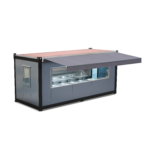
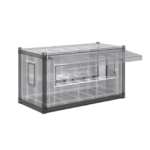
Every unit is 240 cm wide and 273 cm high on the outside. Lengths are 300 cm for the 10ft, 450 cm for the 15ft, 600 cm for the 20ft and 1200 cm for the 40ft. The 10ft weighs 1,750 kg empty and the 20ft 2,500 kg. Ask us for the floor plan of your size before you order equipment, so you know your counter, refrigeration and extraction fit the way you want to work.
These companies have already chosen to work with us


